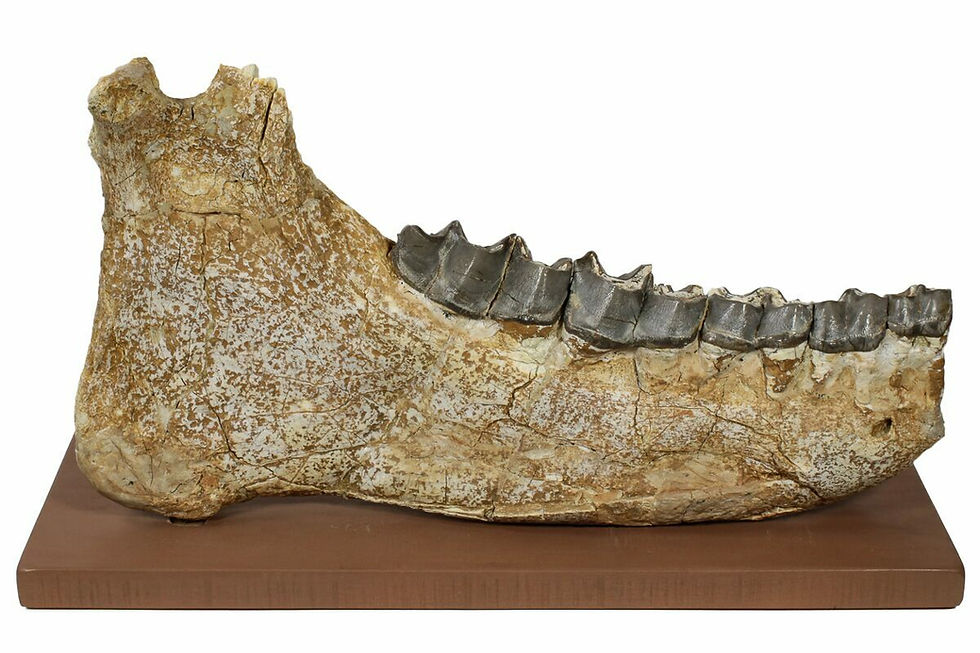
This Pappocetus jaw captures a turning point in evolution. Ten strong teeth line the massive jawbone, built for catching prey in shallow seas. These early whales had left the land behind but hadn't yet mastered ocean life. They hunted using sight and smell, not the echolocation that modern whales use today.
Forty million years ago, Morocco's ancient coastline was home to animals in transition. Pappocetus swam with paddle-shaped front limbs and shrunken hind legs. They spent time in water and on shore. The thick tooth roots and worn edges show a top predator adapting to hunt underwater. The jaw represents the first steps in an incredible journey from land mammal to ocean giant.
30" Fossil Primitive Whale Jaw - Morocco
Specimen Details
Species: Pappocetus lugardi
Age: Middle Eocene (~40 Million Years)
Location: Gueran, Boujdour, Western Sahara, Morocco
Formation: Aridal Formation
Size: 30" long
Condition & Restoration
Professional preparation consistent with museum standards for large marine mammal fossils. Minor crack repair and gap fill restoration applied to maintain structural integrity. All ten original teeth are preserved and stable. Restoration work is minimal and typical for specimens of this size and age.